For decades, the idea of working alongside a robot belonged firmly to the realm of science fiction. Today, that boundary is blurring faster than most professionals anticipated. From warehouse floors to corporate lobbies, robotic systems are beginning to occupy space once reserved entirely for human workers — and the shift is accelerating.
From Factory Lines to Open-Plan Offices
Industrial robots have long been a fixture in manufacturing environments, performing repetitive, high-precision tasks with mechanical efficiency. What is different now is the ambition. A new generation of machines — more autonomous, more mobile, and increasingly capable of interpreting unstructured environments — is being designed with general office settings in mind.
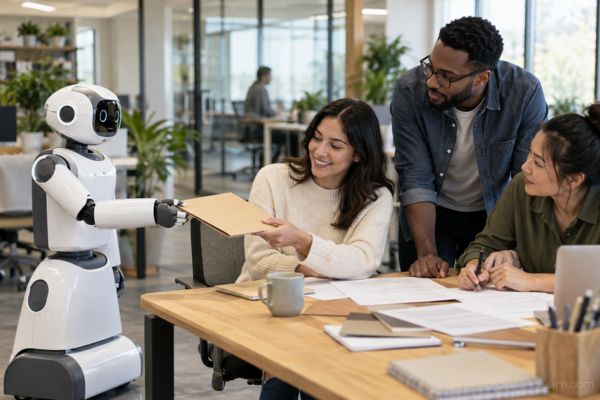
These are not stationary arms welding car frames. They navigate hallways, interact with people, handle documents, and in some cases, participate in routine meetings as an active presence. The technology underpinning them combines advances in computer vision, natural language processing, and physical dexterity in ways that were not practically achievable even a few years ago.
What Robots Can (and Cannot) Do in an Office
Current robotic systems entering office environments tend to excel at defined, repeatable tasks: delivering mail within a building, monitoring security, managing inventory in storerooms, or providing informational assistance at reception desks. In these roles, they offer consistency and availability that human staff, stretched across multiple responsibilities, cannot always match.
However, meaningful limitations remain. Robots still struggle with the kind of contextual judgment, emotional intelligence, and creative improvisation that characterize most professional work. A robot can schedule a meeting; navigating the subtle politics of who should be invited to it is another matter entirely. Nuance, empathy, and ethical reasoning continue to be deeply human capacities.
The Human Response: Anxiety and Adaptation
Unsurprisingly, the prospect of robotic colleagues provokes a range of reactions among workers. Concerns about job displacement are legitimate and should not be dismissed with easy reassurances. History shows that technological transitions create winners and losers, often unevenly distributed across income levels and industries.
At the same time, researchers and organizational psychologists point to evidence that humans are generally adaptable. Workers who have experience alongside automated systems often report that their roles shift rather than disappear — moving toward higher-order responsibilities that require judgment, leadership, or creativity. The critical question is whether that transition is managed thoughtfully or left to chance.
Designing Workplaces for Human-Robot Collaboration
Organizations beginning to explore robotic integration are discovering that it is not simply a technology problem — it is a design and culture problem. Physical spaces may need to be restructured. Communication protocols must be established. Employees need to understand what robots are authorized to do, what data they collect, and how decisions are made when something goes wrong.
Trust, it turns out, is the central variable. Workers who understand a robot’s capabilities and limitations tend to collaborate with it more effectively than those who are simply told to accept a new system. Transparency from management is not optional — it is foundational.
Looking Ahead
The trajectory is clear even if the timeline is not. Robots will become more capable, more affordable, and more socially accepted as each generation of technology matures. Businesses that engage with this shift proactively — investing in workforce development, establishing ethical guidelines, and maintaining open dialogue with employees — are likely to navigate it far more successfully than those that treat it as a purely operational upgrade.
The office of the future may well include robotic co-workers. The more important question is not whether that will happen, but how workplaces choose to prepare for it — and whose interests they center in doing so.