
Somewhere beneath the rolling hills of New Zealand, or deep under a private estate in the American Midwest, a fully equipped underground bunker sits waiting. It has a swimming pool, a cinema room, years’ worth of food supplies, and walls thick enough to withstand catastrophic events. Its owner is a billionaire. And increasingly, this is not a rumor — it is a trend.
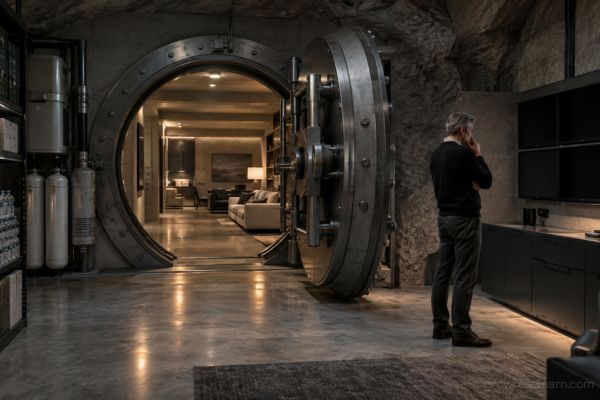
The rise of so-called “doomsday bunkers” among the ultra-wealthy has moved from the fringes of survivalist culture into the mainstream conversation about how the very rich prepare for an uncertain future. What once seemed like the obsession of a fringe minority is now a recognized market segment, with specialized architecture firms, luxury shelter developers, and private security consultants catering exclusively to high-net-worth clients.
A Market Built on Fear
The bunker industry is, at its core, a fear industry. Demand tends to spike during periods of geopolitical instability, environmental disasters, or global health crises. When the world feels fragile, those with enough capital choose to insulate themselves — literally — from its consequences.
What makes this phenomenon particularly telling is not the bunkers themselves, but who is building them and why. These are not people preparing for minor disruptions. They are preparing for civilizational collapse: pandemics, nuclear conflict, climate catastrophe, social unrest. The scale of their preparation mirrors the scale of their anxiety.
And that anxiety, it turns out, is contagious. When the ultra-wealthy begin fortifying themselves against the end of the world, it sends a signal — however unintentional — to everyone else that the end of the world may actually be coming.
Luxury as a Last Resort
What distinguishes billionaire bunkers from traditional emergency preparedness is the extraordinary level of comfort involved. These are not spartan survival chambers. They are equipped with wine cellars, gyms, medical suites, and entertainment systems. Some feature simulated daylight windows and hydroponic gardens. The goal is not simply to survive, but to maintain a lifestyle — even in the event of catastrophe.
This raises uncomfortable questions about inequality and moral responsibility. In a genuine global emergency, access to safety should ideally be shared. But these structures are designed for exclusivity by definition. They are expressions of private survival in a world that may require collective solutions.
The bunker is not just a room underground. It is a statement about who gets to endure what comes next — and who does not.
What These Bunkers Reveal About Us
Beyond the individuals building them, billionaire bunkers function as a kind of cultural mirror. They reflect widespread anxieties that cut across class lines: fears about climate change, political instability, technological disruption, and the erosion of social trust. The difference is simply that billionaires have the resources to act on those fears in extreme and visible ways.
In this sense, the bunker is less a practical solution and more a symbol — a physical manifestation of the belief that the systems holding civilization together are no longer entirely reliable. When those with the most to gain from the current order begin preparing for its collapse, it invites the rest of us to ask uncomfortable questions about the stability of the world we share.
Preparing for Failure or Causing It?
Some critics argue that the bunker mentality among the ultra-wealthy is itself a form of social harm. When influential individuals invest in private escape routes rather than systemic solutions, it can signal a withdrawal from collective responsibility. Resources that could fund climate adaptation, public health infrastructure, or democratic institutions are instead channeled into personal fortresses.
Others take a more pragmatic view, noting that individual preparedness — at any level — is a rational response to genuine risk. The problem, they suggest, is not the preparation itself, but the vast disparity in who can afford to prepare adequately.
A Reflection Worth Taking Seriously
Whether one views these underground palaces with concern, curiosity, or criticism, they are impossible to dismiss as mere eccentricity. Billionaire bunkers are the most extreme end of a spectrum of modern anxiety — one that spans across economies, cultures, and generations.
They remind us that uncertainty is not a problem that wealth can entirely solve. And perhaps more importantly, they challenge all of us to consider whether the most valuable investment in an uncertain future might not be a reinforced concrete wall, but a more resilient and equitable world above ground.