George Lucas, the filmmaker behind some of the most enduring stories in cinematic history, has long believed that images tell stories as powerfully as words. With the opening of the Lucas Museum of Narrative Art, that conviction has found a permanent home — a cultural institution dedicated entirely to the art of visual storytelling.
The museum represents decades of personal passion. Lucas has spent much of his life collecting paintings, illustrations, and cinematic artifacts that, in his view, share a common thread: the ability to communicate human experience through image and sequence. Now, the public finally has access to that vision.
What the Museum Celebrates
Unlike traditional fine art institutions that organize collections by period or geography, the Lucas Museum frames its galleries around narrative — the universal impulse to tell and receive stories. Visitors can expect to encounter:
- Original film art, including concept illustrations and production paintings from landmark Hollywood productions
- Classic American illustration, spanning editorial art, magazine covers, and book imagery that shaped popular culture across generations
- Digital and contemporary works that explore how storytelling evolves alongside technology
- Interactive experiences designed to engage visitors of all ages in the mechanics of narrative construction
The breadth of the collection challenges the boundaries between so-called “high” and “popular” art. By placing a film storyboard alongside a painted canvas, the museum argues that the desire to tell stories is fundamentally democratic — it belongs to every medium and every audience.
Architecture as a Statement
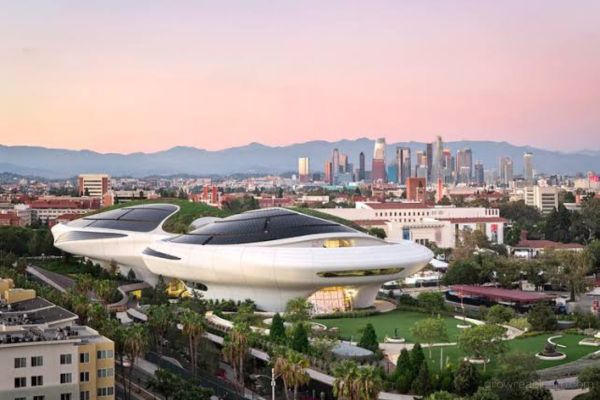
The building itself has attracted considerable attention. Designed to complement its surroundings while projecting a sense of imaginative possibility, the museum’s architecture is conceived as an extension of the collection’s themes. The structure invites visitors to experience space and movement as part of the storytelling journey — a fitting approach for an institution whose founder spent his career choreographing worlds on screen.
Why Narrative Art Matters Now
The opening of the Lucas Museum arrives at a moment when the conversation around storytelling — who tells stories, whose stories are told, and what forms those stories take — feels particularly urgent. Streaming platforms have transformed how audiences consume narrative. Artificial intelligence is beginning to generate images and scripts. Social media has made everyday people into authors of their own visual biographies.
In this context, a museum devoted to the craft and history of narrative art offers something valuable: perspective. It reminds visitors that humanity’s drive to communicate through image and sequence is ancient, resilient, and constantly reinventing itself.
Visual storytelling has always been central to how cultures understand themselves — and how individuals understand each other.
That idea, implicit in every gallery of the Lucas Museum, feels less like a curatorial choice and more like a necessary reminder.
A Cultural Landmark in the Making
For educators, artists, film enthusiasts, and casual visitors alike, the Lucas Museum of Narrative Art has the potential to become one of the most distinctive cultural destinations in the country. Its ambition is not simply to display beautiful objects, but to illuminate the process behind them — to pull back the curtain on how stories are constructed, visualized, and made to resonate.
George Lucas has always been fascinated by myth, structure, and the mechanics of wonder. This museum may be his most personal project yet — not a galaxy far, far away, but a very human celebration of why stories matter at all.